
You’re probably here because you’ve watched other creators post #prpackage hauls, tag a few brands yourself, maybe sent a couple of DMs, and heard nothing back.
That usually happens for one reason. You’re approaching PR like a consumer asking for free product, while brands handle it like a marketing channel.
If you want to learn how to get PR from brands, the shift is simple but important. Stop pitching yourself as someone who wants stuff. Start presenting yourself as someone who can help a brand earn attention, trust, content, and sales.
Beyond Free Stuff Becoming a Brand's PR Partner
A lot of creators chase PR lists for the wrong reason. They want the package, the unboxing, the social proof of being “chosen.”
Brands want something else.
They want creators who can make their products look credible in the market. They want content that feels less staged than a studio ad. They want reactions, comments, saves, clicks, and feedback they can use. That is why creator gifting keeps growing as a serious part of PR and not just a nice extra.
In 2025, 64% of PR campaigns feature creators or influencers as a core strategy, with 70% of brands reporting their highest ROI from these collaborations, according to PRLab’s public relations statistics roundup. That changes the conversation. There is significant opportunity here, but only for creators who can prove business value.
That is the mindset I’d adopt before sending a single email. You are not asking for a favor. You are proposing a lightweight marketing partnership.
What brands are buying
A PR package is rarely just “free stuff.” It is usually one or more of these:
- Authentic content: The brand gets product-in-use footage, lifestyle imagery, testimonials, or UGC-style clips.
- Social proof: A creator mention can make a product feel current, visible, and trusted.
- Audience insight: Brands learn how a niche audience responds to messaging, packaging, product features, and objections.
- Future deal flow: A gifting campaign often helps a team identify who should move into affiliate or paid work.
Creators who understand this tend to pitch better. Their emails sound like a partner’s note, not a wishlist.
Tip: Before outreach, write one sentence that defines your value in business terms. Example: “I create product-led UGC for skincare brands that need believable demos and audience feedback, not just polished lifestyle shots.”
If you need help sharpening that positioning, good creators often borrow from a definitive thought leadership content strategy because it forces you to articulate what you know, who it helps, and why your angle is distinct.
Laying the Groundwork Your Pre-Pitch Checklist
Most failed outreach happens before the pitch is written. The creator is unclear, the media kit is weak, the numbers are missing, or the brand fit is off.
Preparation fixes that.

Define the angle before you define the ask
Brands do not need another “lifestyle creator.” They need someone specific.
Your positioning should answer three questions:
- What kind of content do you make
- Who responds to it
- Why a brand should care
Weak version: beauty creator, love trying new products.
Stronger version: UGC creator for affordable skincare and haircare brands, with content focused on routine demos, texture shots, before-and-after storytelling, and buyer-objection handling.
That second version gives a PR manager something usable.
Build a media kit that feels operational
Your media kit does not need to be fancy. It needs to reduce friction.
Include:
- Short bio: One paragraph with your niche, audience, and content style.
- Audience overview: Age range, location, interests, and any strong niche alignment you can verify from platform analytics.
- Content examples: Direct links to your best Reels, TikToks, Stories highlights, or product photos.
- Past brand fit: This can include gifted work, affiliate work, or even unpaid organic posts that performed well.
- Deliverable menu: State what you can create. For example, unboxing Reel, testimonial-style Story frames, static image carousel, product demo video, or whitelisted UGC asset.
- Performance screenshots: Native analytics matter more than claims typed into a PDF.
Calculate the metric brands care about
One of the most useful filters brands use is engagement rate.
According to PR Package’s guide on getting PR from brands, brands evaluate creator performance using this formula: Engagement Rate = (Likes + Comments + Saves) / Total Followers. The same source notes that a rate significantly above the 2 to 5% industry average can make a micro-influencer more attractive than a macro-influencer when it is backed by historical data.
That matters because follower count alone is a weak pitch.
Here is the practical version:
| What to show | Why it matters |
|---|---|
| Average engagement rate | Proves active audience interest |
| Best-performing branded or product posts | Shows commercial relevance |
| Saves and clicks when available | Indicates deeper intent |
| Three to six months of trend data | Shows consistency, not a one-post spike |
A creator with a smaller but responsive audience is often easier for a brand to trust than a bigger account with flat reactions and weak niche fit.
Key takeaway: A simple screenshot from Instagram or TikTok analytics can do more work than a page of self-promotion.
Qualify brands before outreach
Do not pitch randomly. Build a shortlist.
A useful screening method:
- Start with visible gifting behavior: Check hashtags like #prpackage, #gifted, and #brandambassador.
- Look at comparable creators: Review similar accounts and note repeat brand relationships.
- Check brand fit: Ask whether your audience would realistically buy, use, or care about the product.
- Watch launch timing: New product drops, seasonal campaigns, and reformulations create better openings than cold generic outreach.
Good outreach starts with relevance. If the product does not make sense on your page, the pitch will feel forced and the brand will spot that immediately.
Crafting the Perfect Pitch That Brands Read
Most outreach dies in the inbox.
That is not because creators are untalented. It is because their emails are vague, self-centered, or sent to the wrong person at the wrong brand.
Only 3% of pitches receive responses from journalists and brand managers, and 73% of recipients reject pitches because they are irrelevant. That should make your standard sharper, not lower. A good pitch is not a numbers game. It is a relevance game.
Why email beats DMs
DMs are fine for light visibility. They are weak for serious outreach.
Email feels professional, searchable, and easier to forward internally. A brand manager can send your pitch to influencer marketing, PR, paid social, or a founder in seconds. A DM usually stays stuck in one inbox.
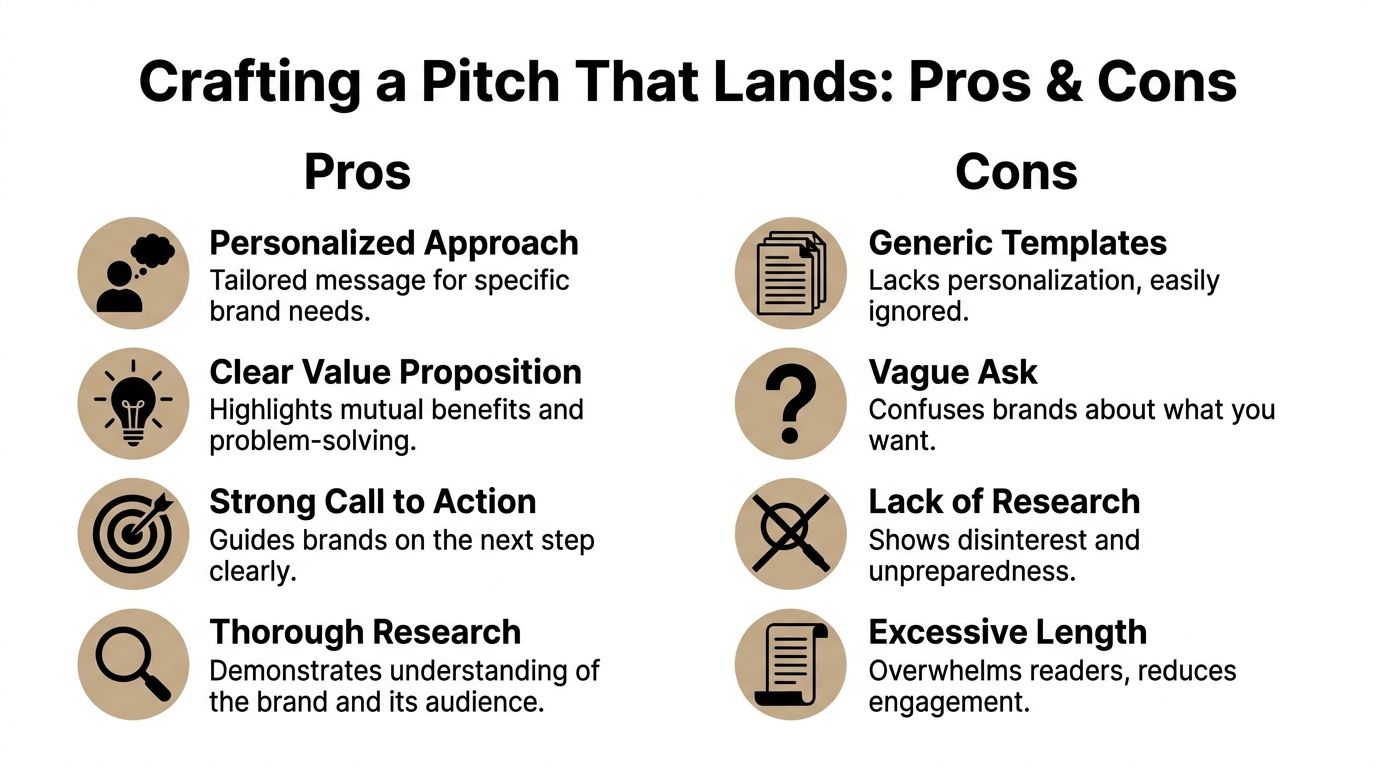
When I review pitches, the most effective ones do four things fast:
- they prove the sender knows the brand
- they explain audience fit
- they offer a clear content angle
- they make the next step easy
Subject lines that earn an open
A subject line should tell the brand what kind of opportunity this is.
Better options:
- UGC creator for [Brand] with strong audience fit
- PR consideration for [product line] launch
- Creator pitch for [Brand], product demo and feedback content
- Organic UGC idea for [Brand]’s [specific product]
- Gifted collaboration idea for [Brand]
Bad subject lines tend to be generic or needy. “Collab??” and “I’d love free products” are easy to ignore.
A pitch template that works
Use this as a base, then personalize it hard.
Subject: UGC creator for [Brand] with strong fit for [product/category]
Hi [Name],
I’m a [creator type] focused on [niche]. I create [content type] for an audience interested in [relevant problem, product type, or lifestyle category].
I’m reaching out because I noticed [specific product, campaign, launch, retailer placement, message angle, or recent post]. My audience responds well to [relevant format], and I can see a natural fit between your brand and the kind of content I already make.
A few quick points that may be useful:
- My content focuses on [specific angle]
- My audience is especially interested in [relevant buying intent or interest]
- I track performance through engagement, saves, clicks, and content-level feedback
- Examples of similar content: [link] / [link]
If you’re open to PR consideration, I’d love to test [specific product or range] and create content that feels native to my audience. If helpful, I can also send a short media kit with analytics screenshots and content examples.
Best,
[Name]
[Email]
[Social links]
That works because it sounds like a business note. Not a fan letter.
Personalization that counts
Adding the brand’s name is not personalization. Referencing something real is.
Good signals include:
- a product line you use or want to test
- a recent launch or campaign
- a gap in their creator mix
- a format they seem underusing, such as direct-response UGC or educational demos
If you want another useful reference point for structure, this guide on Crafting the Perfect PR Email Template to Get Media Coverage is worth reviewing because it reinforces clarity, brevity, and a clean ask.
A short visual summary helps when you are editing your own draft.
What to leave out
Some things weaken a pitch fast.
| Include | Avoid |
|---|---|
| Specific reason you fit | Generic praise about loving the brand |
| Relevant metrics | Long life story |
| Direct links to work | Large attachments in first email |
| Clear ask | Vague “let’s work together” language |
| Short copy | Multiple paragraphs repeating the same point |
Tip: If your pitch cannot be understood in under a minute, it is too long.
The Art of Follow-Up Negotiation and Deliverables
The first reply is not the finish line. It is where a lot of creators either become professionals or stay stuck in the “freebie” category.
A sloppy follow-up, an unclear agreement, or vague deliverables can turn a good opportunity into wasted effort.
Follow up without becoming annoying
A non-response is not always a rejection. People miss emails. Internal approvals stall. Launches move.
A clean follow-up system helps. Keep a simple tracker with:
- Brand name
- Contact name
- Date pitched
- What you offered
- Follow-up date
- Reply status
- Notes
The recommended follow-up interval in the verified guidance is 7 to 14 days, from Impact’s micro-influencer PR package guidance. That is a practical cadence because it keeps you visible without crowding the inbox.
Follow-up email:
Hi [Name],
Following up on my note below in case it got buried. I’d still love to explore a fit with [Brand], especially around [specific product, launch, or content angle].
If helpful, I can send over a short media kit and a few relevant examples.
Best,
[Name]
Short. Respectful. Useful.
How to handle yes, no, and maybe
Once a brand replies, your job changes. You are no longer trying to get noticed. You are trying to define the partnership clearly.
If they say yes
Reply with enthusiasm, then confirm expectations.
Ask:
- What product or range are you considering sending?
- Are there required deliverables?
- Is posting expected, or is this send-for-consideration only?
- Are there deadlines, talking points, or usage rights?
- Is there a contact for approvals or logistics?
If they say no
Stay professional. Thank them, keep the door open, and move on.
A strong response:
“Thanks for the reply. I appreciate it. I’d be glad to stay in mind for future launches if the fit changes.”
That line preserves the relationship.
If they say maybe
Maybe usually means timing, budget, campaign priority, or uncertainty about fit.
Answer by reducing friction:
- offer a more customized concept
- send your media kit
- suggest a lighter first test
- reference a relevant content example
Clarify deliverables before product ships
Here, creators often lose influence. They assume the expectations are obvious. They are not.
Confirm these points in writing:
| Deal point | Why it matters |
|---|---|
| What is being sent | Prevents mismatch and vague promises |
| Whether posting is required | PR gifting and contracted deliverables are not the same |
| Content format | Reel, Story, TikTok, static post, raw UGC, review, or unboxing |
| Timeline | Avoids last-minute pressure |
| Usage rights | Important if the brand wants to reuse content |
| Exclusivity | Relevant if you work with competing brands |
If a brand is asking for specific deliverables, usage rights, revisions, or deadlines, you are no longer in casual gifting territory. That may justify a paid conversation, or at minimum a clearer negotiated exchange.
Key takeaway: “Gifted” should never mean “undefined.”
Treat tax and compliance like a professional issue
One topic most creators ignore is taxes. That is a mistake.
A verified business-context source notes a critical issue here: with Form 1099-K thresholds at $600 for digital payments in the US, “free” gifts can create a tax liability that 68% of micro-influencers don’t track, as discussed in this YouTube business-context reference. Even if the operational details vary by your situation and market, the professional move is the same. Track every gifted product, every paid invoice, and any paperwork tied to creator income.
Use a spreadsheet or bookkeeping tool and log:
- brand
- date received
- product description
- stated value if provided
- campaign status
- whether any payment was involved
- invoice or tax form status
Creators who handle this cleanly are easier to trust. They also avoid the panic that comes later when gifted product stops feeling free.
Delivering Value and Building Long-Term Relationships
Getting the package is the smallest win in this process. The true win is becoming someone a brand wants to brief again.
That happens after delivery.

Make content the brand can use
A lot of gifted content is pretty but useless. It looks nice in a feed, but it does not show the product well, answer objections, or feel native enough to repost.
The creators brands remember usually do a few things better:
- Show the product quickly: Packaging, texture, fit, application, setup, or result.
- Use a clear angle: Problem-solution, first impression, routine integration, comparison, or educational demo.
- Keep brand safety in mind: Clean framing, readable audio, no messy competitor clutter.
- Make edits modular: Hooks, body clips, and product shots that can be reused elsewhere if rights allow.
Send a simple performance report
If you want to turn PR into paid work, close the loop.
Do not assume the brand saw the post. Do not assume they know how it performed. Send a short report.
A clean format:
Campaign recap
- content delivered
- live links
- posting dates
Performance snapshot
- screenshot of reach
- screenshot of impressions
- screenshot of engagement
- clicks or taps if relevant
- notable comments or audience feedback
Brief insight
- what angle worked
- what questions came up
- what you would test next
Here, many creators start to look like marketing partners instead of hobbyists.
Tip: A one-page PDF or a tidy email with screenshots is enough. The point is not design polish. The point is proof.
Turn one gifted send into a paid proposal
Once you have delivered and reported, ask for the next step naturally.
Try this:
“Happy to build on this if useful. Based on the response, I can see a strong fit for a broader UGC package around [product line or audience segment]. If your team is planning future launches, I’d be glad to put together a paid concept with deliverables and usage options.”
That works because it is based on evidence. Not hope.
Stand out with a sharper creative angle
Most creators send the same soft pitch and produce the same safe content. That makes them replaceable.
A stronger approach is to bring a point of view.
One verified example from Notably PR’s pitch-angle article is this contrarian framing: “While others focus on viral Reels, my authentic UGC drives 3x higher conversion for e-commerce, hitting 4.5% vs the 1.2% industry average.”
You do not have to copy that exact line. The lesson is what matters. Bring a usable argument.
For example:
- your audience responds better to educational demos than trend-led audio
- your niche values routine proof over polished luxury imagery
- your content performs best when you handle buyer hesitation directly
That is how creators stop blending in. They stop offering content alone and start offering informed creative judgment.
Conclusion Your PR Journey Starts Now
The creators who win with brand PR do not wait to be discovered. They build a process.
They research brand fit. They pitch with data. They follow up like professionals. They confirm deliverables in writing. They deliver useful content. Then they report results and open the door to paid work.
That is the essential answer to how to get pr from brands.
It is not about chasing random packages or sending the same message to fifty inboxes. It is about becoming easy to trust, easy to brief, and easy to rehire.
If you are starting small, that is fine. A smaller creator with a clear niche, a solid engagement story, and a clean outreach system can be far more attractive than a bigger account with no proof and no positioning.
Start with one category. Build a shortlist of brands that fit your audience. Tighten your media kit. Send a better email than the average creator sends. Then treat every yes like the start of a business relationship, not the end of a wishlist item.
That is how free product becomes repeat product. Then affiliate work. Then paid retainers. Then long-term brand trust.
If you want a faster way to find relevant contacts and real outreach opportunities, Who Pays Influencers can help you move from scattered cold pitching to a more organized PR and paid-collab pipeline. It works best as a launchpad for creators who already understand how to present value and want better brand lead flow.